
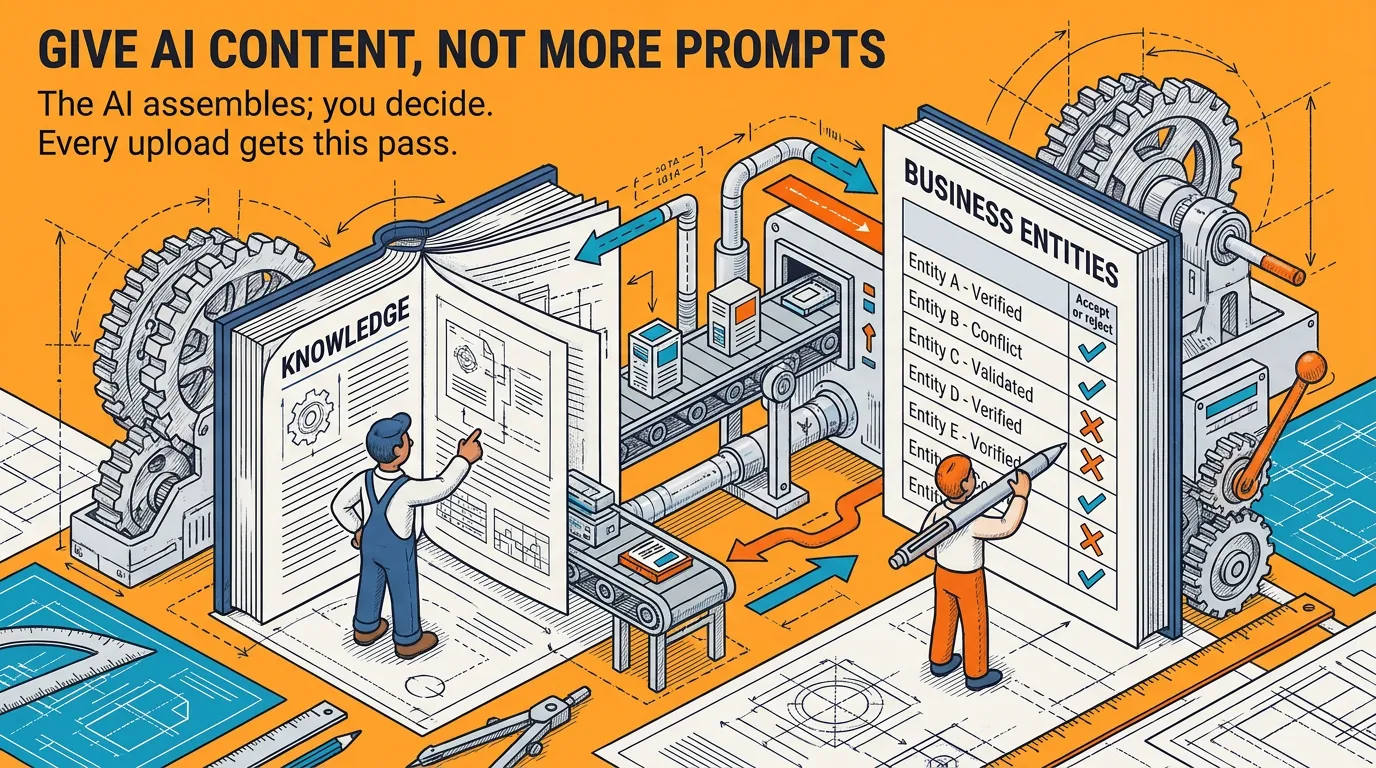
Give AI Content, Not More Prompts
Whether AI builds you a useful business model depends far less on the prompt you type than on the content you give it to read: the glossary that settles what counts as a customer, the requirements from the last workshop, the vendor data dictionary nobody has opened since go-live.
Content is step two of the loop this how we use AI series follows: set the context, bring in the content, describe the outcome, review the proposal, then refine and approve. The last session, Business context is not an AI prompt, set the context in your own words. This one fills the library the AI reads while it works, because no clever instruction later makes up for thin material here.
Watch this in action:
How DeltaVault reads a document into your AI knowledge base
Getting content in takes about a minute:
- Open Knowledge and click Upload.
- Select a document type and set the scope, organization-wide or a single project.
- Attach the file and click Upload.
The document goes up exactly as you wrote it, unchanged.
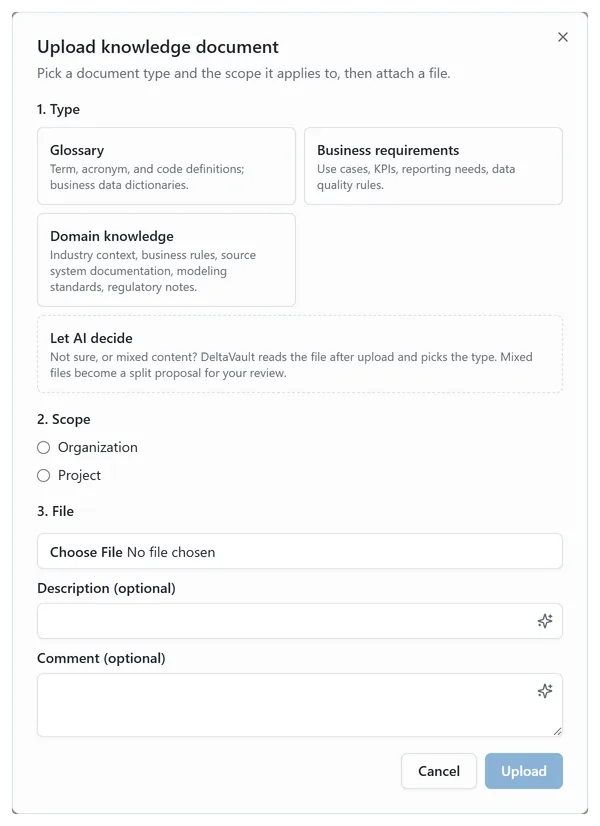
The type and the scope are the only two decisions, and DeltaVault will pick the type for you when the file is mixed.
What happens next is where DeltaVault earns its place. It reads the document against the conventions you defined in step one, pulls out the business entities and the attributes they carry, quotes them verbatim rather than paraphrasing, and lists them on the document’s page for you to accept or reject. When your requirements keep circling back to a customer, DeltaVault notices. Everything it finds carries forward into the modeling workshop as a compact digest. Every upload gets this pass, and you never have to ask for it.
What happens when three documents define the same thing?
Upload enough documents and sooner or later three of them will describe the same concepts in three different ways. Select them, click Consolidate, and pick the output type, or let the AI decide for you. Two switches change how deep the run goes.
Optimize for business categories drafts a second document alongside the merge: a business glossary grouped under your own category lanes, together with proposed business entities you can apply straight to your business model.
Extended consolidation sends the same merge to several AI vendors and puts a judge over their proposals, so a definition only one vendor thought worth keeping survives instead of quietly being dropped.
The review is the actual work
Every run ends on the same screen, and it is the most important one in the product. The review lays out what the document consolidation merged, why, and which content went in, with the full proposed body underneath it. Read it properly. From there you can accept the document, reject it, or refine it by describing the change you want in plain language and checking the rewrite before it lands. Merged sources are archived rather than deleted, so nothing you started with is lost, and data governance survives the merge. The AI assembles; you decide.
When the content is not yours to upload
Sometimes the material is not yours to upload at all, and that route carries a real caveat: you are handing the whole first draft to the AI. Point Research at a public repository or a documentation site, and several AI vendors research it independently, each with live web search, then consolidate their findings into drafts. Every draft arrives with the web sources that vendor actually cited attached as links. We pointed it at the Willibald sample dataset from the German Data Vault User Group, where the source requirements are written in German. The drafts came back in English.
Research is not instant. Our run took close to five minutes, which is worth weighing against the alternative of transcribing the material yourself. Then review the output with the care you would give any upload. Open the cited sources, read a vendor’s unmerged document when you want to know what it actually said, and accept, edit, or reject each draft one at a time. Accepted drafts land in the knowledge base scoped to your project, beside everything you uploaded.
A model built from your own documents arrives speaking your language. A model built from whatever fit in a chat box speaks somebody else’s. Open Knowledge, upload the three documents your team already argues over, and consolidate them. Next session, Enough talk, let us see it in action, we put the whole library to work in a business modeling workshop.