
Star schema and ontology without modeling the business twice
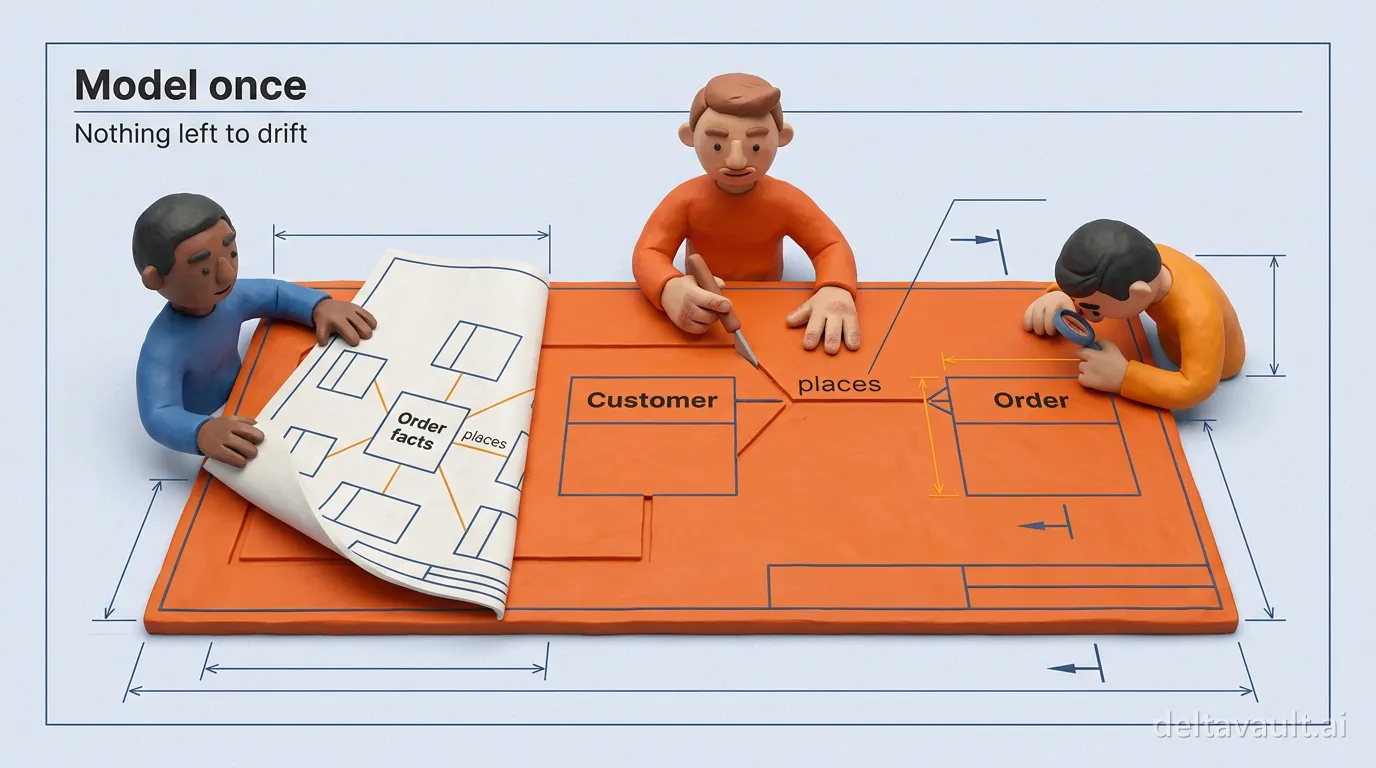
- You model the business once. An agent reads that model directly, and the star schema your reporting tool needs is generated from the same source.
- A silver table keeps the shape of its source, and integration happens by exception, only when a requirement calls for it.
- When a language model queried the SQL schema, it answered 16 percent of questions correctly. Over a knowledge graph of the same tables, its accuracy rose to 54 percent.
- When you write the ontology first and generate the star schema from it, the two have no way to drift apart.
- The test is your own question set, with checked answers and one question the agent should decline, rerun each time a table climbs a level.
Here is the whole argument in one line: you model the business once. An agent reads that model directly, and the star schema your reporting tool needs is generated from the same source.
Two comments, one on You don’t need to unlearn Data Vault and one on From Data Vault to an AI-ready silver layer, arrive at the same question from opposite directions. The first comes from a Data Vault modeler who suspects we’ve only given the work a new name. The second comes from a team planning star schemas and an ontology for 2027 that would rather not model the business twice. Both get the same answer: you model it once.
Is an ontology just a Data Vault business model with a new name?
The first reader accepts two of our premises: meaning is written as metadata, and tables are generated from it. What they object to is where we’ve drawn the line. In their view, writing the sentences down is the business model, and building from those sentences is the integration.
They’re right about the first half. When you write down the things your business runs on (how each one is identified, how they relate, and what describes them), you have your business model. Write it so a machine can read it, and you have an ontology. You do that work once, with your business expert in the room, before any table is built. We call the approach that starts there AIMS, short for AI-ready, Meaning-first Silver.
The second half is where we part ways. A silver table keeps its source’s shape, and integration happens by exception, only when a requirement calls for it.
Suppose finance needs one customer list across two systems. What they need is a shared key: one key that stands for the same customer in both systems. Once a match is approved, both source keys receive that shared key on the entity’s key register, which is the list of every business key the entity has. If someone then needs a single combined record, it sits beside that list as a golden record, with a rule for each attribute that decides whose value wins. Because the key, the match rule, and the survivorship rule were already written down, neither the shared key nor the golden record amounts to a second model.
Reports still get their own data marts, as they always have. The difference in AIMS is that a data mart reads from the meaning layer, which is the business model plus the mappings that tie silver columns to it. Each part of the ontology then becomes one part of the star schema:
- Key register → a dimension’s natural key.
- Relationship role → a role-playing dimension reference.
- Event entity (something that happens) → a fact table’s grain, set by the grain sentence that states what one row means.
- Shared key, where matching exists → a conformed dimension’s key map, so every mart shares one Customer.
SQL schema 16%, ontology 54%: what text-to-SQL proves for data agents
The same reader also checked our evidence, and they’re right about that too. The 2023 benchmark by Sequeda, Allemang and Jacob took 13 of the 199 tables in the Object Management Group’s Property and Casualty insurance data model, generated sample data for them and asked 43 questions. Against the SQL schema, the language model answered 16 percent correctly, while over a knowledge graph of the same tables it answered 54 percent. Both numbers, however, come from a schema that was already modeled. Nobody tested a source-shaped silver layer where one customer appears across several systems.
We concede that point plainly. The 54 percent came from an ontology and mappings written over those same 13 tables, which is exactly the lever AIMS pulls: meaning written over tables that already exist. The benchmark pulled that lever on a tidier substrate than any real silver layer, though, and no study we cite tests the multi-source case. The nearest field result is a May 2026 Microsoft engineering evaluation, in which one platform’s data agent climbed from under 10 percent to 69 percent once it had column descriptions and domain instructions, then reached 88 percent after three rounds of storing corrected queries. The errors that remained were business-logic errors.
That leaves the test that matters to you: your own question set, with checked answers and one question the agent should decline, run each time a table climbs a level. The four levels (Identified, Related, Described and Integrated) range from an agent that can count a table’s rows to one that gives one answer per customer across systems.
That makes one customer across two systems a level 4 question. Until an approved match puts a shared key on the key register, the agent should decline that clause, and your question set should expect it to.
Does keeping your reporting tool mean modeling twice?
The second reader is planning star schemas plus an ontology for 2027 and wants to know whether keeping Power BI means modeling twice: once for presentation tools and once for AI.
You model once. Write the ontology first and generate the star schema from it, so the two have no way to drift apart. The dimensions, their keys, and their roles already exist as statements in the model. Because the agent reads that model directly, with every relationship’s role and cardinality stated, it can join tables without doubling a row.
Reverse the order and the problem shows up quickly. If you build the star schema first and write the ontology afterward, you end up with two hand-maintained descriptions of the same business. The first time someone changes what a customer is in one of them, the two disagree. Generating the star schema from the ontology avoids this, because the schema changes when the sentence changes:
- Edit the definition.
- Regenerate whatever depends on it.
- Compare the table’s data contract, which is the summary of everything stated about that table.
Modeling once only holds if nothing reinterprets the model later. The AI drafts the model from each table’s profile and the mappings you’ve approved, but a person still decides what a key identifies, whether customers in two systems are the same customer, and how much history to keep. Templates then build everything, including the star schema, from approved metadata alone, so nothing is left to guess at run time.
How to generate a star schema from an ontology in five steps
- Pick one business area to start with.
- For that area, write down each entity with its business key in the system that issued it, each relationship with its role and cardinality, and the meaning of every column that identifies, relates, holds a code, or is sensitive.
- From those statements, generate the star schema for the area.
- Then give an agent the same statements.
- Finally, run your question set against both the star schema and the agent.
Wherever the dimension and the agent disagree about what a customer is, you have found the place where you were about to model the same thing twice.
DeltaVault removes that gap: the business model you draw on the canvas is the same versioned metadata that its templates render from and its AI reads.