
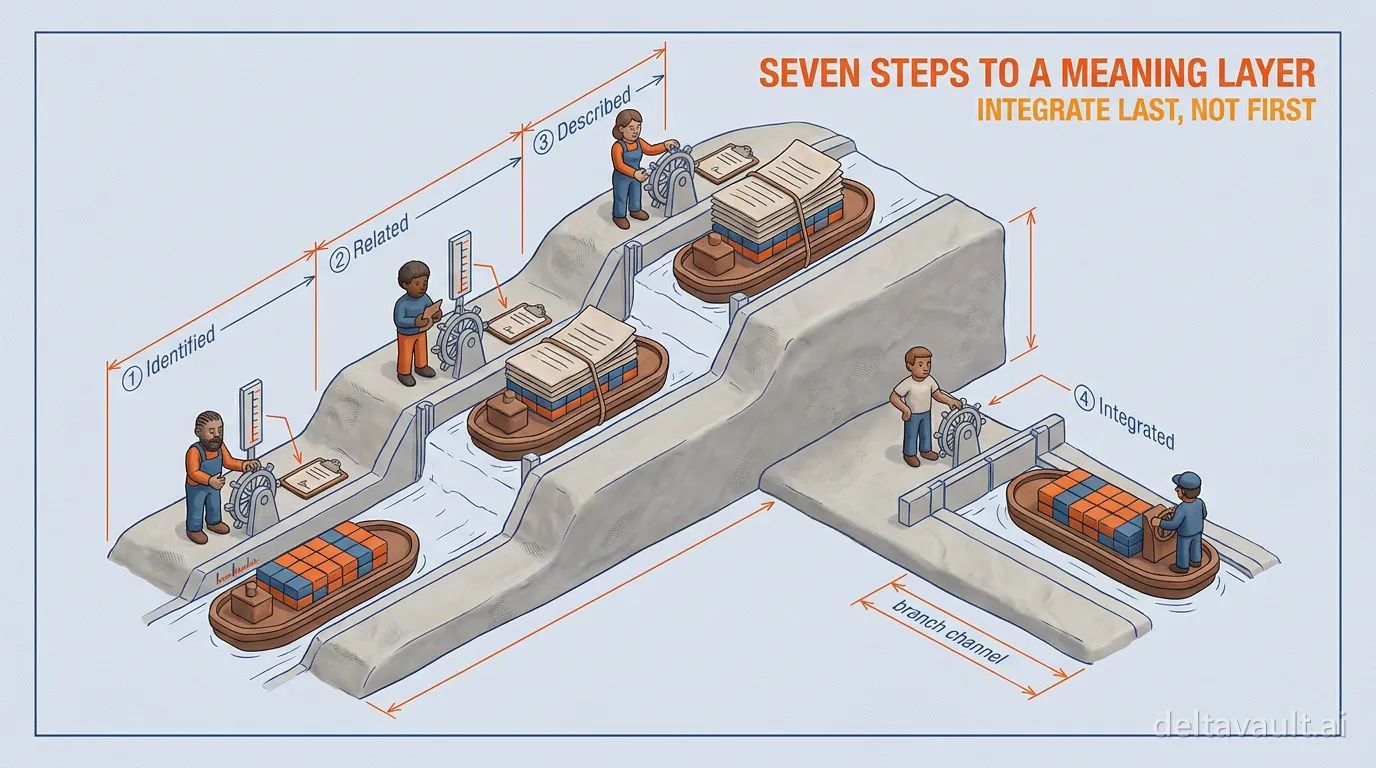
Seven steps to a meaning layer
Where do you start on Monday if you want an AI agent to read your silver layer? You take one business area through seven steps, and each step ends in a check you can run.
A silver layer can keep the shape of its sources
For decades, third normal form and Data Vault integrated every source up front and wrote business meaning into table shapes, which was right while only people read it. An agent can read meaning written as metadata over the tables. So silver, the cleaned layer between raw bronze and report-ready gold, can keep its sources’ shape. The business model plus the mappings that tie silver columns to it carry the meaning. That’s the meaning layer, and building silver this way is AIMS, short for AI-ready, Meaning-first Silver.
Where a six-step method picks a shape on stated factors, AIMS makes the choice once: silver keeps its sources’ shape, and integration comes last.
A table can pass every test and still say nothing about what its rows mean. So AIMS measures what a table tells its reader in five meaning levels, from 0 Typed to 4 Integrated. The seven steps take one business area up those levels, and at each, your team’s AI proposes and a person approves.
Seven steps, each ending in a check
1. Name the entities before anyone maps a column. Run a business modeling workshop, define each entity and say what kind of thing it is, which decides its class. An agent that doesn’t know what one row means counts the wrong thing, so each entity also gets a draft line saying it, its grain sentence.
You’re done when your business expert agrees all three for every entity. It fails on the undefined noun, three systems saying “customer” about an account, a person and a billing party.
2. Profile the sources during the workshop, and keep their shape. Every restructuring is a decision somebody must keep defending, so each source table gets one silver table at the same grain, a source-aligned table. By default it’s a view over the part of bronze that keeps every version a source delivered, persistent staging. So your audit trail exists before silver starts.
You’re done when each source table has its source-aligned table at level 0 and an accepted profile. It fails on “we will model later”, because anyone reporting from level 0 invents the meaning in the report.
3. Write identity in a key you can read. Customer 123 in your order system and customer 123 in your sales system can be different customers. A key only means something inside the system that issued it, its record source. So for each entity and record source, your AI proposes the values that identify one thing, in a fixed order, its business key. A person approves each, with rules for source changes and deletes, its history and delete policies. One customer’s key reads awlt||AU||00001042: record source code, company code, customer number.
You’re done at level 1, Identified, when every business key passes its uniqueness test.
4. Relate every reference by its role. Two columns both called customer get joined on whichever one the analyst found first. So every reference gets a role, a cardinality and a policy for one that doesn’t resolve, and each role gets its own key column.
You’re done at level 2, Related, when every relationship has a role and its orphan count is reported.
5. Describe the columns everything depends on first. Joins, codes and governance rules depend on the columns that identify, relate, hold a code or hold sensitive data. Those critical columns are mapped first, each to a business attribute. And a code column gets an approved code mapping, so the order system’s C means Cancelled. Level 3, Described, asks every column to be mapped or, where no business attribute fits, marked source-only. But publishing asks it only of the critical ones.
You’re done when the critical columns are, and you know what share of the rest is mapped, its attribute coverage.
6. Publish, then let gold read the table. The catalog’s summary of a table is that table’s data contract, from the grain sentence to what the table can’t be trusted for, its known limitations. So publishing is a review. Gold may read a table once it has level 2 complete, its critical columns at level 3 and the release checks on its acceptance checklist passed. That’s the publish gate.
You’re done when the contract is versioned and the first consumer reads the table.
7. Integrate last, then ask an agent. Integration comes only where a business requirement calls for it. That’s integration by exception. When finance asks for one customer list, both systems’ numbers for the same customer must meet in one shared key. Matching does that, with an exact-match rule on tax number that a person approves. One combined record per customer, if finance needs it, is a golden record. That’s level 4, Integrated, where it’s earned.
You’re done when an agent’s answer to a real business question cites the contract and declines each clause no mapping covers. It fails on entity resolution by guesswork, because a merge on a likely match is wrong in every join downstream.
Why finish one business area before the next?
Every approval compounds, as a fact for the next agent question and a demonstration for the next suggestion. Two half-finished business areas give gold nothing it may read yet.
How high should each business area climb? Rerun a set of checked business questions after every contract change. The level where the answers come back correct is the level it needs.
You don’t need a new modeling method. You need a meaning layer, the meaning your methods always carried, written where machines can read it, with the people who always decided it still deciding.
Start this week.
- Pick the business area your gold layer reads most.
- Write down the questions an agent must answer or decline there.
- Book its workshop.