
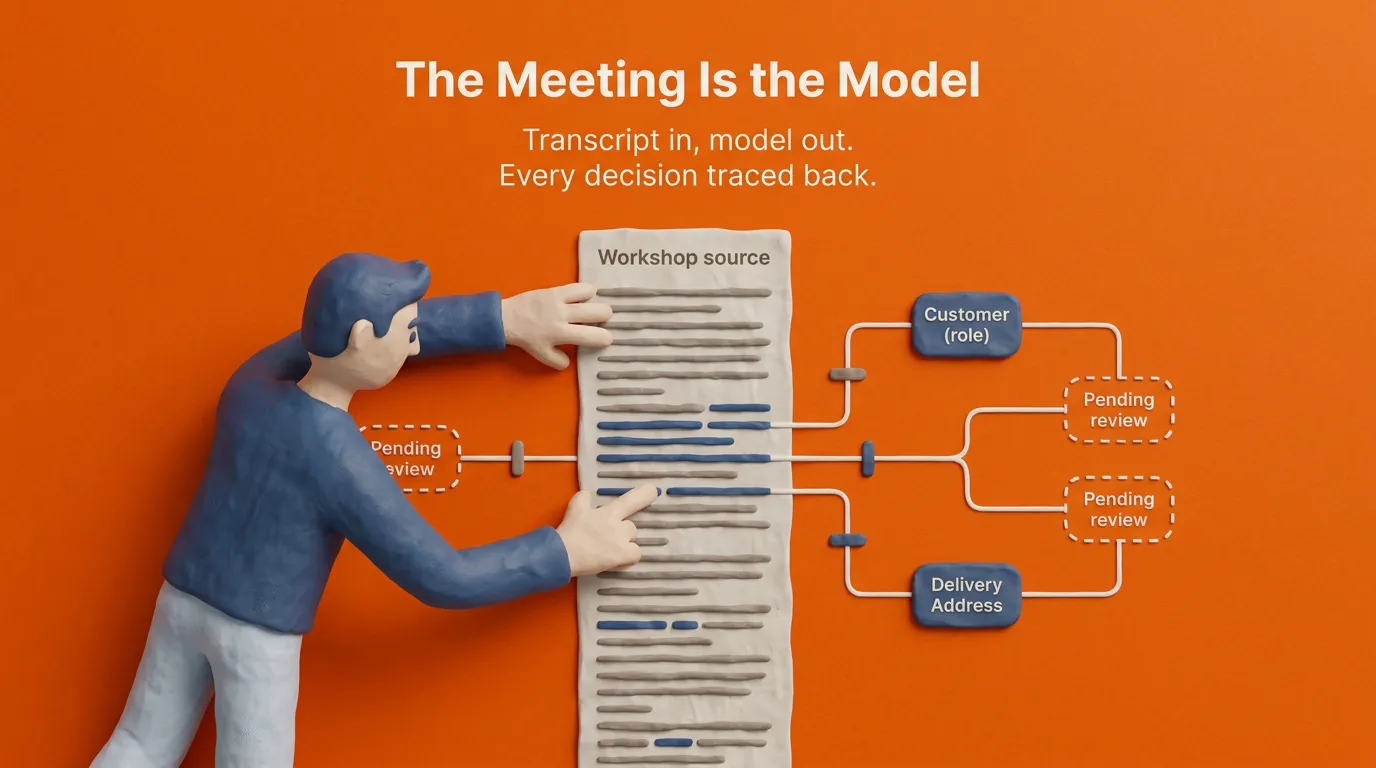
The Meeting Is the Model
The most productive modeling session your team ran this week did not happen in a modeling tool. It happened in a Teams meeting, and everything it produced is sitting in a transcript nobody will read twice.
You know the meeting. The customer model finally got the room it deserved, the right people were asking the real questions, and the argument about whether a customer is a role or a membership actually got settled. Then the meeting ended and the model walked out in five people’s heads. What happens next is the part every data person recognizes: days later, someone rebuilds the discussion from memory in a diagram the room never saw, and the detail dies in the gap between the meeting and the model.
The Teams transcript was sitting there the whole time. It deserves better than being filed as minutes, because it is source material.
Watch this in action:
How DeltaVault turns a transcript into a conceptual data model
Here is how we ran ours. Open the business model, start a data modeling workshop, and attach the meeting transcript. The workshop reads it for that one run and never stores it. We switched attribute discovery off so the pass stayed purely conceptual, and we left the effort dial on Standard, because with a transcript this detailed the effort setting is not where the quality comes from. The content carries the run, and a well-run meeting feeds it better than any setting can.
One pass later the proposals were on the canvas, drawn dashed over the model they are headed for: club partner, customer, a delivery address and a residence, connected by the relationships the conversation had already named. Nothing had been written to the model yet. Everything sat there waiting for review.
Every proposal points back at the room
Open Customer and the rationale quotes the discussion directly: Sarah and Michael were explicit that this is a role, not a membership. The workshop judged the roadshow event and the order out of scope for this model, so it parked both of them with the reasoning attached, one decision away from coming back the day you want them. Every proposal can be kept, left out, or changed, and every one of them shows you why it is there.
It even caught us repeating ourselves. One relationship already existed on the model, agreed in an earlier session as “has a registered”, while the transcript called it “represents”. Instead of proposing a duplicate, DeltaVault flagged the relationship that was already there, and we kept the name we had agreed the first time.
Two changes finished the review. We typed “rename residence to home address” into the chat, and it made exactly that change and reported back. Then Apply wrote the kept concepts and relationships through the same review path as every other metadata change, and we opened the customer entity and captured the synonyms the discussion had used. From transcript to applied conceptual data model took minutes.
What you are holding now is the artifact the meeting never used to produce: a model you can put in front of your stakeholders so you can ask the only question that moves conceptual modeling forward. Is this what you meant?
The discipline runs back into the meeting
The second benefit of AI data modeling from a transcript has nothing to do with the tool. Once you know the conversation will drive a conceptual model, you run the conversation differently, pushing for precision while the people who hold it are still in the room. Is that a role or a membership? Which address are we actually talking about? What do we call this thing when the club is involved? Ask those questions in the moment and the transcript stops being a record of what was said. It becomes the specification the meeting was always trying to write.
In the next session we will connect this model to the source systems that feed it. Until then, treat your next modeling discussion as source material: start a workshop and bring the transcript.