
AI for modeling, or modeling for AI?
The data modeling tools have settled on their AI feature: you describe your business in a prompt, and the tool drafts the entities, keys and relationships for you. That gets the direction backward. It automates the one step that needed a person and skips the one that needed the machine.
An AI-assisted data modeling draft knows every business but yours
Start with what the draft knows. It knows every business that ever published a schema, which amounts to knowing none in particular. Joe Reis described the result in early 2026: the AI produces a syntactically valid schema, with keys and normalized structures all in place, and “The data model looks convincing, but it’s trash.” The logistics partner with its own way of splitting a shipment isn’t in that schema. Neither is the jurisdiction where “customer” means something different. Nothing that makes your business yours is in it, because none of that knowledge was ever written down anywhere an AI could read it.
Where does that knowledge live? It lives in your people, the ones who would have argued over the whiteboard. The drafting tool asks them to tidy a guess instead of asking them what they know. Then it hands the finished diagram to a person, the one reader who never needed the diagram to arrive faster.
Data modeling for AI: where the meaning comes from and where it goes
Ask of any AI modeling feature: where does the meaning come from, and where does it go?
If the meaning comes out of the model’s training and goes into a diagram for a person to correct, the AI is working for you, and you get the old output faster, with the same gaps. If the meaning comes from your people, is written down once as metadata, and goes to every agent that answers a question about your data, you’re working for the AI. That’s data modeling for AI, and from then on the AI works for everyone who comes after you.
That second direction is the one the evidence rewards. In 2026, Michael Rumiantsau and Ivan Fokeev gave three frontier models the same retail schema, with and without one hand-written document describing it. The document ran a few pages on what each table holds, how the tables join and what the codes mean. Every model gained 17 to 23 points. Nobody drew that document faster. Somebody wrote it once, and every agent that answers a question after that can read it.
Jason Cui and Jennifer Li at Andreessen Horowitz reached the same conclusion from the investor’s chair in March 2026: “data and analytics agents are essentially useless without the right context.” They call the place that context lives a context layer.
So what is a context layer? It’s the written-down meaning an agent reads before it answers a question about your data. The business context for AI they put in it is metric definitions, canonical entities, identity resolution, governance rules and the tribal knowledge nobody wrote down. That’s a data model, written where a machine can read it. It’s the same kind of document that gained every model in the retail study 17 to 23 points.
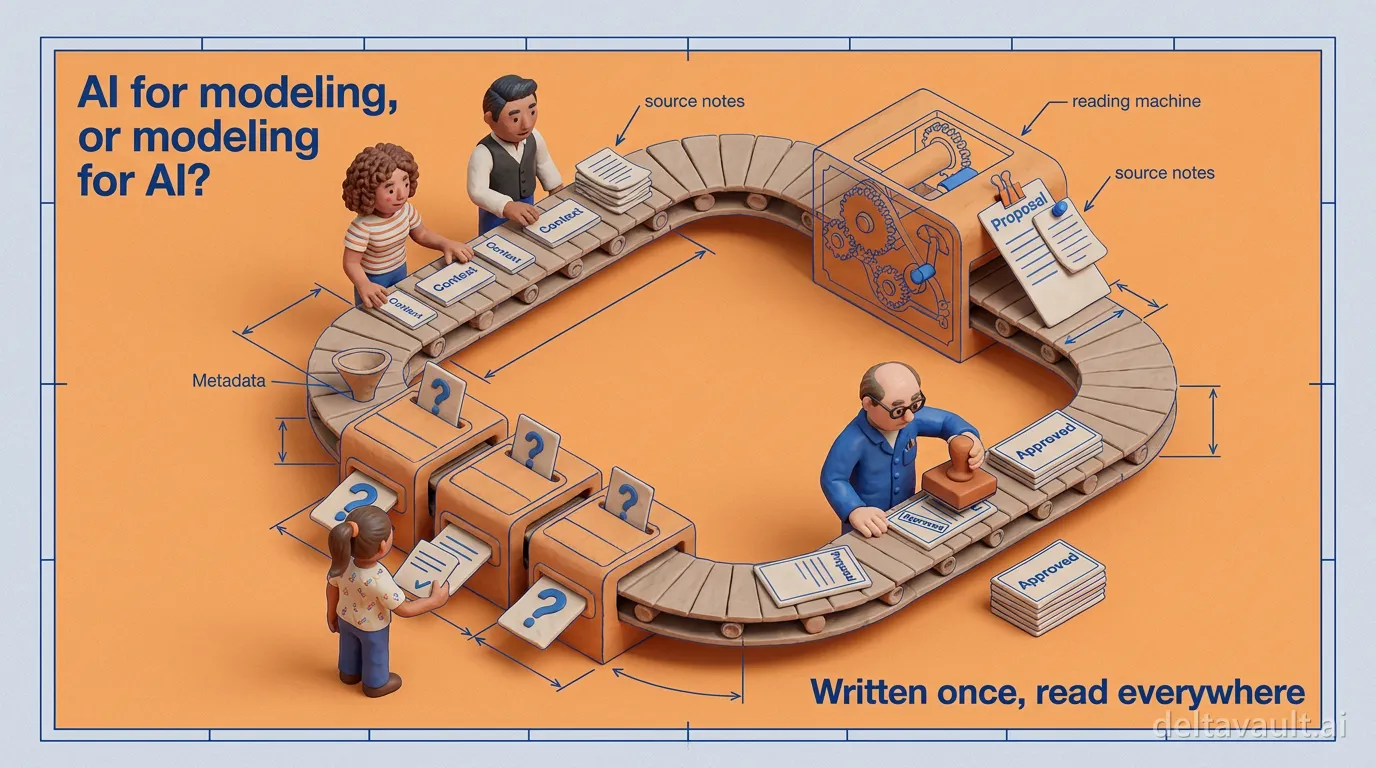
An AI-assisted modeling loop where AI proposes and a person approves
So the fix isn’t to keep the AI out of modeling. The fix is to run the loop in the direction the meaning actually flows.
- Set the context first. You write your vocabulary, your categories, your modeling conventions and your governance rules once, before any content arrives. Only your people can supply them.
- Bring the content. That means the source metadata, the requirements, the documentation and the meeting transcripts. The AI reads that content as evidence, not as a prompt.
- Describe the outcome in business language. Say what you need, not how to build it.
- Review the proposal with its evidence. The AI proposes an entity, a key, a mapping or a relationship, and it shows you the passages in your content that support each one. A proposal is not an approval.
- Approve, then generate. Only approved meaning becomes metadata, and that metadata is what the build reads and what your agents read.
Notice where the AI sits in that loop. It still drafts: the AI proposes, a person approves. But it drafts from your evidence against your context, and the person who knows the answer gets asked before the draft, not after it. The approved result is the model, written as metadata and read by every agent that answers a question about your data. Your database was never your business, and neither is a schema that a model guessed from everyone else’s schemas.
How to evaluate AI data modeling tools in five minutes
The test for AI data modeling tools takes five minutes. Open the feature, draft a model, and ask two questions.
- What did the draft read? If the answer is “the prompt”, the meaning came from the training data, and so did the gaps. If the answer is “your context and your evidence, from the source metadata to the meeting transcripts”, the meaning came from your people.
- Where does the approved model go? If the answer is “a diagram file”, you’ve modeled for a person who never needed the help. If the answer is “the metadata your agents read”, you’ve modeled for AI.
Then do the one thing that moves the number. Take the definition your team argued about last quarter and write it down in full sentences, as metadata a machine can read. That is the same move that gained every model in the retail study 17 to 23 points, and it only has to be written once.
In DeltaVault, every AI write arrives as a proposal, and every run records exactly what context was sent, so you can answer both questions yourself instead of taking the answer on trust.