
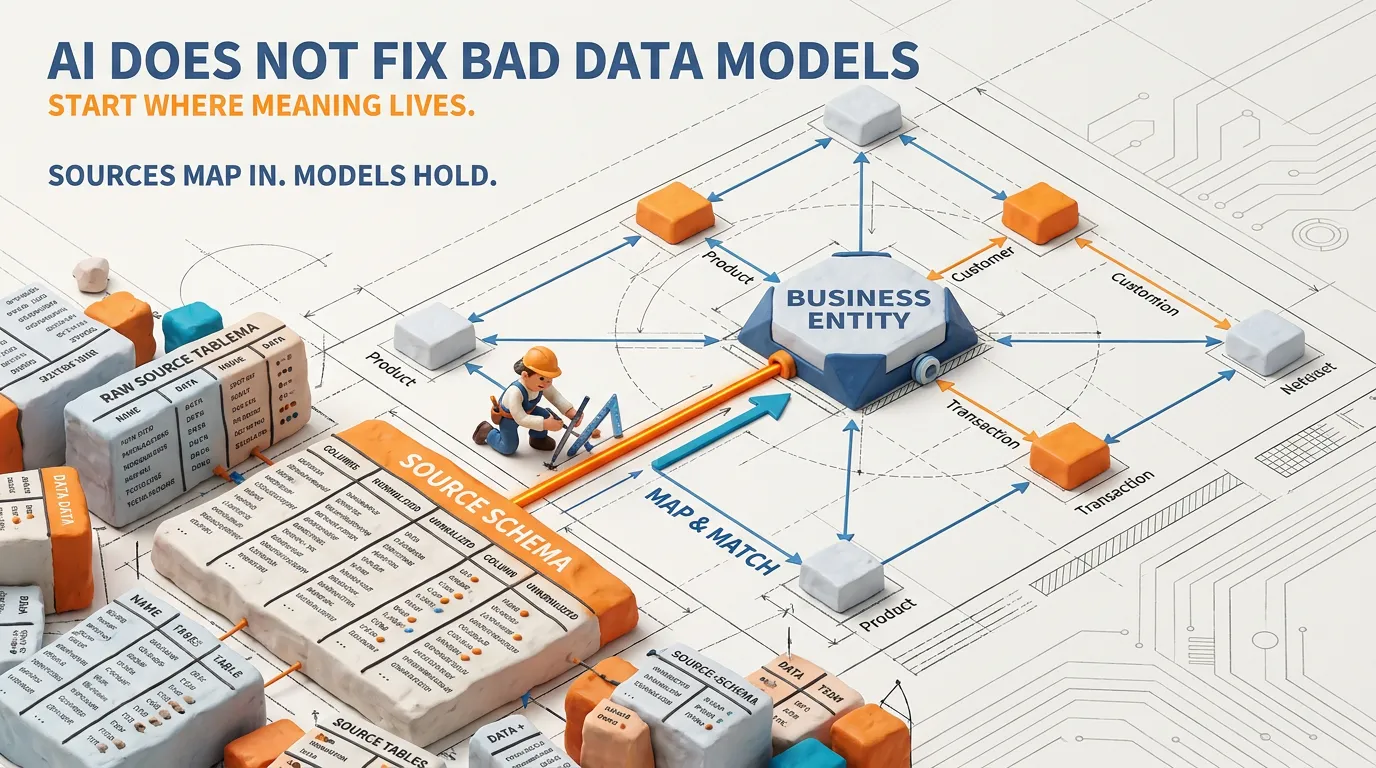
AI does not fix bad data models
Point an AI at your source schemas, ask it for a business model, and you will get one. What comes back is your source schema with better labels, and that is the only thing it could be, because the schema was the only thing you gave it to read.
Why does AI data modeling hand you back the source model?
Every wave has arrived with the same promise. Machine learning would surface the patterns hiding in the warehouse. Generative AI would write the definitions nobody had time to write. Agentic AI would run the whole operation while you slept. Each wave got faster at producing artifacts from the same input, and not one of them improved the input.
Sit with that for a moment, because it is the part that matters. A model derived from the wrong source does not improve because you generate more of it, faster, in more places. It just arrives everywhere at once, in a confident tone and a tidy layout.
Your source schema was never trying to explain your business
Source systems are built to store data, and most do it well. The schema you are pointing the AI at was shaped by write throughput, vendor upgrade paths, and a normalization argument somebody won in 2011. None of those forces cared what your business calls things.
You can read it in the names.
- A table is named after a module in a vendor’s product catalog.
- A status column carries six values decoded in application code nobody has opened since the last major upgrade.
- Three tables have customer in the name, where one is a billing account, one is a login, and one is what your sales team actually means.
That is not bad design. It is designed for a different purpose.
An AI reading that schema can tell you something looks like a customer table. It cannot tell you which of the three your finance team counts as a customer, because that fact was never recorded there. It lives in a business glossary, in a requirements document, and in an argument your team has been having for two years.
Start where the meaning actually lives
DeltaVault starts from the other end. You upload what your business already wrote down into a knowledge base: glossaries, requirements documents, vendor data dictionaries, domain notes. Whenever they fit the context budget, glossaries and requirements go to the AI in full, so the definitions your team argued its way to get read directly instead of guessed at from a column name.
From there you describe how the business works in plain language, and a guided business modeling workshop proposes the concepts your business names along with the units of work that connect them. Those proposals sort into your organization’s own category lanes rather than a fixed external framework. Each one lands on your model’s canvas with the reasoning attached, so you can accept it, rename it, or throw it out on its own merits. Technical names follow your naming convention and keys follow your key pattern, which stops the AI from reinventing decisions you already made.
How DeltaVault maps source tables into the business model
Sources enter last, and they attach to the model rather than dictate it. Map & Match is how you map source tables to business entities: it proposes which entity each source table represents, and then which attribute each column maps to. Every suggestion carries a confidence score and a written rationale, and nothing changes until a person accepts it. When a table has no entity yet, accepting a match creates a skeleton entity, flagged as derived, so it carries governance from day one and can be adopted into the full model later.
The payoff is in the direction meaning travels. Classify the Email Address attribute once and every column mapped to it inherits that data classification, across however many landing tables, staging tables, and vault satellites the attribute touches. The definition sits on the attribute rather than the column, so a renamed source column costs you a mapping, not a meaning.
Your source model records how one system chose to store data. Your business model records what your company means. Start with what your company means:
- Upload the glossary your team argues over.
- Run a workshop from it.
- Match a single source into the result.