
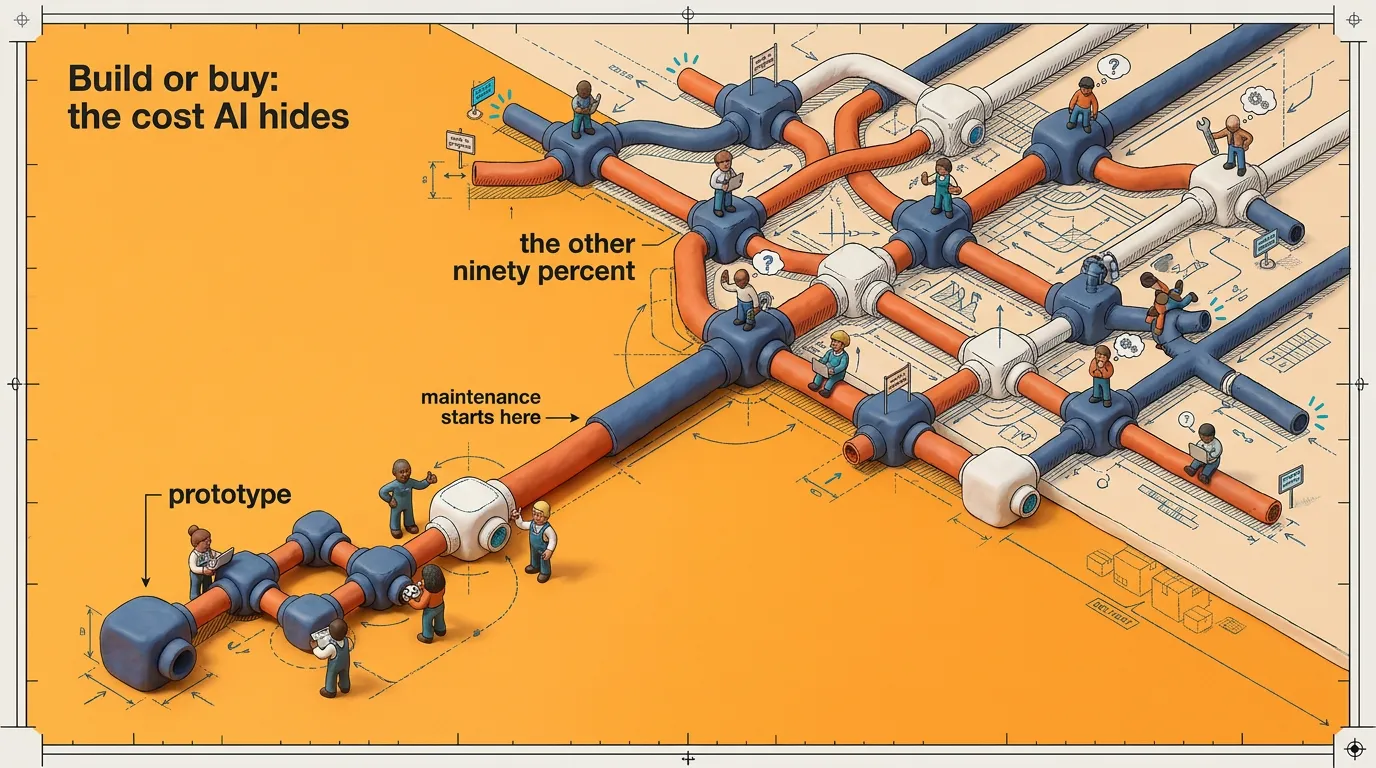
Build or buy: the cost AI hides
AI-assisted coding has made building your own data automation platform look achievable, maybe even cheap. Pipelines that once took a dedicated development team now fall out of a prompt, so the temptation makes sense. But the code was never the expensive part. Owning it is. The question that should decide whether you build or buy a data platform isn’t whether your team can build it. It’s whether your team is prepared to own a second software product for the life of the first.
A working prototype is the cheapest ten percent
An AI-generated prototype that creates a table, loads it, and applies a modeling pattern proves the idea, not the product. Between that demo and production sits everything a platform needs before real workloads can trust it:
- Operations. Error handling, recovery, monitoring, and deployment across environments.
- Governance. Security, permissions, auditability, and version control.
- Change. Platform upgrades, source-system changes, evolving engineering standards, and documentation for the people who weren’t in the room.
Any one of these is manageable on its own. Together they add up to a software product, and AI accelerates that first ten percent far more than it accelerates the ninety that follows.
You just signed up to ship two products
Your modernization program already carries a full slate of deliverables: design the target architecture, migrate the pipelines, rebuild the models, validate the history, and deliver measurable outcomes to the business. Build a homegrown data platform alongside that and you have taken on a second product. It comes with its own backlog, its own testing, its own users (your colleagues), and often its own sprawl of small generated tools that somehow have to behave as one coherent system.
Ask the planning questions before anyone writes a line of it. Can you estimate the platform timeline separately from the lakehouse timeline? Which business deliverables wait while the tooling matures? When a sprint runs short, which of the two products loses? The business asked for one of these products, and that is the one it will judge you on.
When does maintenance on a homegrown data platform start?
Maintenance isn’t a phase that begins once development ends. It begins with the first component you ship, and it doesn’t stop. Cloud platforms change, APIs get versioned, security requirements tighten, and sooner or later the engineer who made the key architectural decisions moves on. Every custom feature you build becomes something your organization supports forever.
Some of that total cost of ownership is direct and visible in salaries and infrastructure. The bigger cost is the work you never get to: every hour spent debugging the internal framework is an hour not spent improving data quality, onboarding a new source, or getting trusted numbers to the people who asked for them. Nobody measures a data team by the internal tooling it built. They measure it by the data it delivers.
How DeltaVault lets you own what is unique and configure the rest
None of this means data teams should never build. Where your organization has genuinely unique requirements, custom development is a strategic advantage. The discipline is in telling those requirements apart from the machinery that looks the same on nearly every platform: staging loads, merge logic, orchestration, lineage, governance checks. Thousands of teams have already rebuilt that machinery. Rebuilding it again earns you nothing except the maintenance bill.
A configurable foundation changes the math. In DeltaVault, a data warehouse automation platform, you describe a table once and the engine writes the platform-correct code for Databricks, Snowflake, or Microsoft Fabric: create-table statements, staging notebooks, merge procedures, and whole workflow definitions, all rendered from the metadata already sitting in your catalog. Change the metadata and the pipelines follow. Where your standards genuinely differ, you don’t fork the product. You override one named section of a shipped template, or bring a template of your own, and upstream improvements keep flowing underneath. That is the flexibility the internal build promised, without turning your data team into a software vendor with one customer.
So before you point the AI at a fresh platform repository, ask the sharper question. It isn’t whether you can build it, because you can. Ask who owns it in year three, what it displaces this year, and whether the parts you’d build are the parts that make you different. Spend your team where it’s irreplaceable, and let the platform generate the plumbing.