
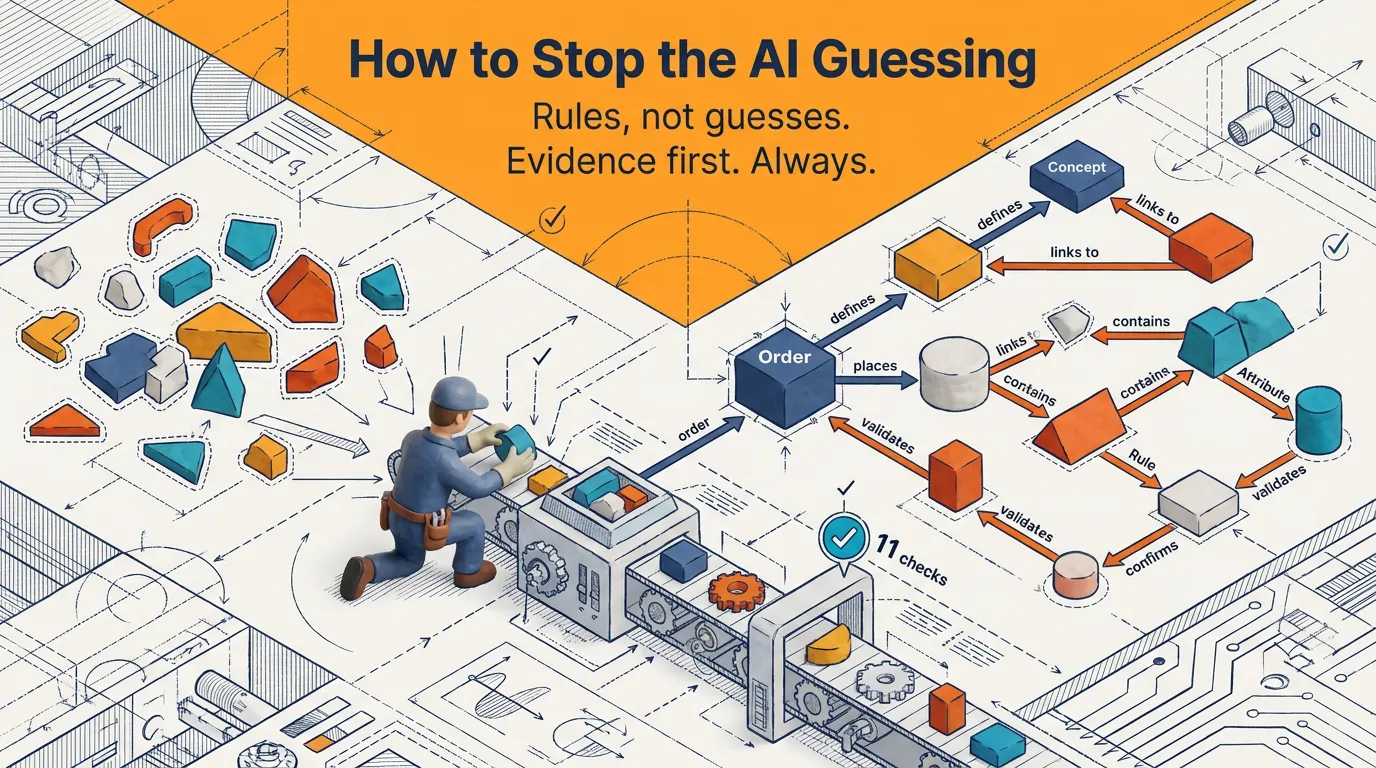
How to stop the AI Guessing
Ask a general-purpose AI to model your business and it goes noun hunting. Every capitalized word in your notes comes back as an entity, “order status” shows up as a thing in its own right, and you spend the afternoon deleting concepts that were never concepts.
The business context is set and the content is in, so this is the run itself. What makes it different is not a cleverer prompt. DeltaVault’s AI business modeling workshop takes seven passes over your stories and clears eleven consistency checks before it proposes a single row, and those rules are what you are really reviewing.
How does the AI decide if something is an entity or attribute?
The first rule sorts everything that follows it. Anything the workshop learns about a concept is identity, relationship, or context, and never two of those at once.
- Identity is how the business tells one occurrence from another, such as an order number or a membership number.
- Relationship is a verb phrase pointing to another concept.
- Context is a descriptive fact recorded about the concept alone: a date, a quantity, an amount, a status.
Run the sort in that order, every time. Does the business use this to tell occurrences apart? That is identity. Does it name another concept? That is a relationship. If neither holds, it is context. The sequence is what does the work here, which is why “order status” comes back as a fact about the Order rather than a concept of its own, and why a customer number never quietly slips through as an attribute.
The happening test decides what earns a node
Verbs are where most AI data modeling goes wrong. Your stories are full of things happening, and the real question is which of those happenings the business treats as a thing in its own right.
The workshop applies one test. A happening earns concept status only when the business names it and identifies it separately: a Payment tracked by a payment reference, a Flight tracked by a flight number. If nobody identifies it, it is not a concept at all, and what you are looking at is the relationship between the concepts it involves. Statuses such as placed, confirmed, and shipped are states, never concepts.
That test cuts both ways, which is the point of having it. It rescues the Booking that reads as a verb in your story, and it refuses the Header and Line rows the business never separately names.
One verb, one pair
Say “the customer orders a product” and a noun hunter hands back “Order orders Product”. The workshop does not, because a verb your story supplies belongs to the one pair it truly describes. That sentence therefore resolves into two relationships: Customer places Order, and Order contains Product.
Every role then faces a read-back test. Read the pair aloud in its direction, and it has to be a sentence your business would actually say: “Customer places Order”, “Order contains Product”. Where it does not read that way, the role is renamed before you ever see it, and a role that only echoes a concept name back never survives.
How DeltaVault flags a business key it cannot evidence
A business key has to be quoted by the business or clearly implied by what it says. So when your stories name no such identifier for a concept, the workshop does not manufacture one out of the concept’s name, and it does not promote whatever number happened to be sitting nearby. It flags the gap instead, and the review tells you which concepts are heading for a placeholder key that you can rename later.
The same discipline applies everywhere else. An attribute is proposed where your evidence records it, never because a customer usually has one.
You still decide all of it
Nothing here has touched your conceptual data model yet. You get one run and one review, and the workshop never stops halfway through to ask you a question. Concepts come back grouped under your own categories, with their relationships underneath, and everything is kept by default. Leave one concept out and every relationship that depends on it goes quiet, telling you which concept is holding it back. Apply is the only write.
There is one more rule worth knowing: your stories are read as evidence, never as instructions. A line buried in a document telling the AI to ignore its instructions, the classic prompt injection, is treated as words in a story, because that is all it is.
So put the rules to work:
- Open a business model and start a workshop.
- Describe how the business works, or bring the meeting transcript.
- Read the review knowing what it had to survive.