
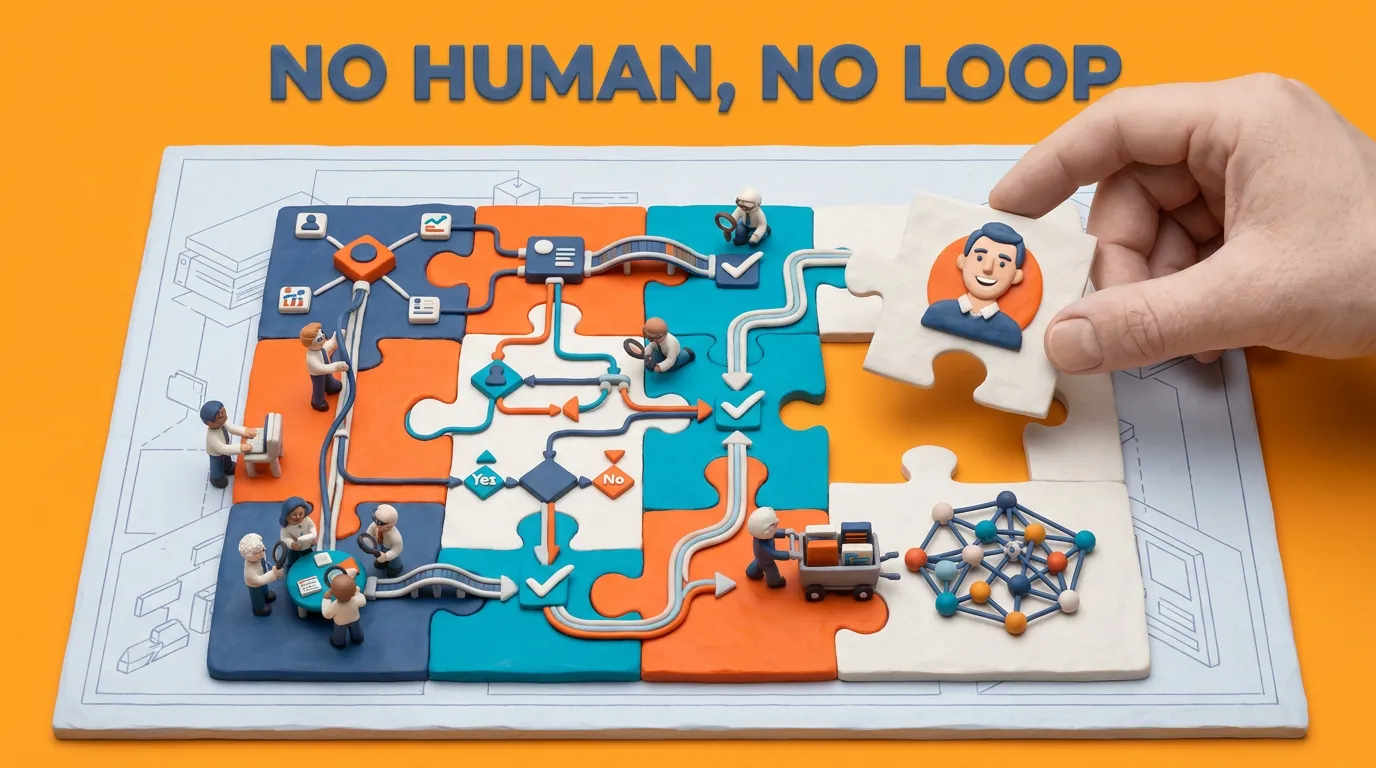
No Human, No Loop
“Human in the loop” is the phrase every AI product reaches for the moment someone asks who is accountable. Listen to where that phrase puts you, though. It puts you inside a loop that already exists, near the end of it, holding an approve button on work a machine started without you.
That is a real safeguard, and it is also an admission. The loop runs on its own. You are the brake, not the engine. Take the person out and the process still turns, faster than before, with nobody left to blame.
Approval that late is a signature, not governance
By the time a proposal reaches the approve button, every decision that mattered is already behind you. Something else chose which concepts exist, what they are called, and which system’s version of Customer won. All that is left is a yes or a no on vocabulary an algorithm settled by reading technical exhaust, and that exhaust records only how one application decided to store something. It never records what your business means by it.
Most of us have approved proposals exactly that way, and not out of carelessness. Checking one properly would have meant rebuilding the reasoning ourselves, from material the tool never put in front of us, against a deadline that assumed the answer was already right. That is the position a late checkpoint puts a modeler in, and it is worth naming for what it produces: a checkpoint nobody can afford to fail is a rubber stamp with better branding. The fix is not more diligence at the end. It is moving the decision to the front, where the concepts and their names are still yours to set.
How DeltaVault starts the loop with your material
DeltaVault runs the other direction. It starts with what your business already wrote down: glossaries, requirements documents, domain notes. Your business glossary and requirements are treated as must-honor types, handed to the model in full whenever they fit the context budget, so the definitions your team argued its way to are read directly instead of guessed at from a column name.
From there you describe how the business works in plain language, or you attach the transcript of the meeting where you settled it, read for that one run and never stored. A guided business modeling workshop then proposes the concepts your business names straight onto your model’s own canvas, and every node carries the reasoning behind it, so you can accept, rename, move between category lanes, or dismiss one at a time.
- Proposed names follow your naming convention.
- Keys are never chosen by the AI: they follow your key pattern.
- Concepts sort into your organization’s own category lanes rather than a fixed external framework.
There is no mode where the machine holds the ontology and you hold an opinion about it.
Every decision you make is the next run’s input
This is where “in the loop” has the sequence backwards. Your decisions do not exit the process once you have made them. They become it.
The model you authored rides into the next skill run as live context: its entities, attributes, and relationships are read on the same branch state the writes will land on. That shared state is the reason re-running the domain skill proposes new work instead of duplicates of what you already accepted. Accepted context flows downward, so a column inherits from its table, a table from its project and its upstream lineage, an entity from its model and its domain. An approved definition carries an audit stamp of who approved it and when, and any later edit sends that definition back to draft.
Map & Match shows the same principle from the other direction. It proposes which business entity each source table represents, and it matches against the models you authored, nothing else. Launch a run in a workspace or project whose model pool is empty and it refuses to run, offering to widen the pool instead.
Without a model there is no match, and without a human there is no loop.
Where does the human in the loop start?
Every vendor will tell you there is a human in the loop and call it AI governance. The claim costs them one approve button, which means it separates nobody from anybody. So ask a better question: where does the loop start? If it starts with a machine reading your systems and ends with you confirming, you are a checkpoint, and your business ontology is whatever the machine inferred on its way past you. If it starts with you deciding what your business means, and everything downstream is built from that decision, then the human is not in the loop at all.
The human is the loop.
Your next data modeling meeting is the test. Bring the transcript into a workshop and watch which end the work starts from.